Birdwalk Higlights for 10/3: Sandy Point, Cousin's Island, Yarmouth (Wow, just wow!)


As a great flight was passing over and through Sandy Point Beach, I made the call for Jeannette to bring the group to meet me at the bridge. The Morning Flight was slowing down, but it just felt like the right call today nonetheless.
It was.
A couple of minutes before Jeannette arrived with the group in tow, a juvenile RED-HEADED WOODPECKER flew by. I was elated, but then the disappointment set in that the group just missed this rarity. But then, the juvenile, almost across the channel and out of view, turned around and returned to the point, alighting in an oak on the other side of the road. Birders arrived from the parking lot, and then I see Jeannette's caravan pass by. As they opened their doors, I started yelling, and the group came rushing around the corner to see the woodpecker still perched. Soon, it alighted in the Magic Elm, and was seen even better by all, before finally making the crossing and disappearing into the mainland.
What luck! What timing! And then, what the <expletive deleted>! Another RED-HEADED WOODPECKER!? An adult!! it flew right overhead, and continued across the channel. Incredible, two Red-headed Woodpeckers!? And then, a minute or so later ANOTHER ONE, also an adult! Right overhead, it's red hood and big white wing-patches in all of its tricolored glory.
Yeah, THREE Red-headed Woodpeckers. Incredible. Insane. And for the record, I have only had this vagrant one other time, ever, at Sandy Point...on October 2nd, 2020. (And of course, Bill Thompson (and others) photographed all three, which I will post to my blog in the next This Week's Highlights entry).
But the fun continued. After working the scrub and trails, encountering some migrants here and there, we entered Camp Soci and hit paydirt once again. With a nice pocket of migrants working the sunny edge, a cuckoo was spotted by Mathew. A YELLOW-BILLED CUCKOO nonetheless. Another rarity!
And even rarer, it sat still for all to see. Then, it caught a large American Dagger Moth caterpillar, and we were all able to watch it carefully manipulate it with its bill, almost peeling it, loosening and removing the irritating hairs. We could even see chunks of the hairs drifting away in the air as it processed it! It was such an amazing insight into how this species is able to eat the fuzzy caterpillars that are inedible to most other species! Speaking of things that eat fuzzy caterpillars, just before the cuckoo was spotted, we were thoroughly enjoying a close PHILADELPHIA VIREO.
While these birds tole the show, we did have other migrants, led by about 30 YELLOW-RUMPED WARBLERS - mostly still on the go overhead, and 15+ WHITE-THROATED SPARROWS in the woods. Additionally, we tallied: 9 SONG SPARROWS, 6 GRAY CATBIRDS, 4 BALD EAGLES, 4 YELLOW-BELLIED SAPSUCKERS, 4 BLUE-HEADED VIREOS, 4 RUBY-CROWNED KINGLETS, 3 BLACKPOLL WARBLERS, 3 SWAMP SPARROWS, 3 HERMIT THRUSHES, 2 BLACK-AND-WHITE WARBLERS, 2 DARK-EYED JUNCOS, 2 COMMON YELLOWTHROATS, 2 PALM WARBLERS, and one each of BLACK-THROATED BLUE WARBLER, SWAINSON'S THRUSH, RED-BELLIED WOODPECKER, COMMON RAVEN, and BROWN CREEPER.
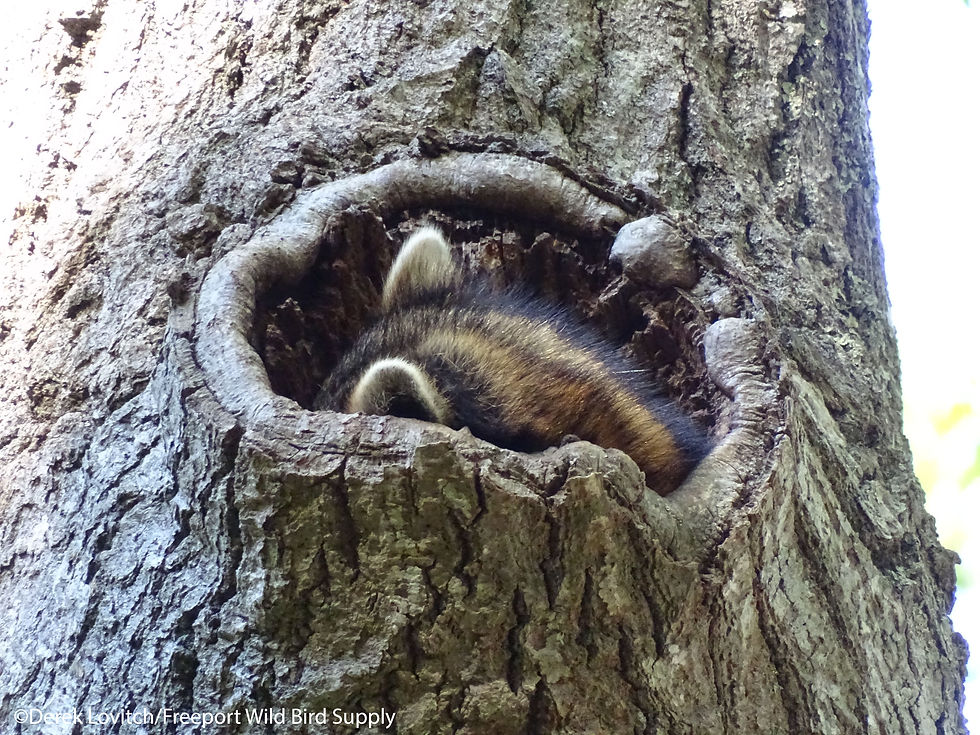
Finishing up with a PILEATED WOODPECKER feeding unusually confidingly on the ground (thanks, Bill!) and RACOON snoozing in a cavity, spotted by Karin I believe, we took one last scan on the emerging sandbar, adding a BELTED KINGFISHER, GREAT BLUE HERON, 5 BONAPARTE'S GULLS, 4 LAUGHING GULLS, and much more to round out an impressive checklist!